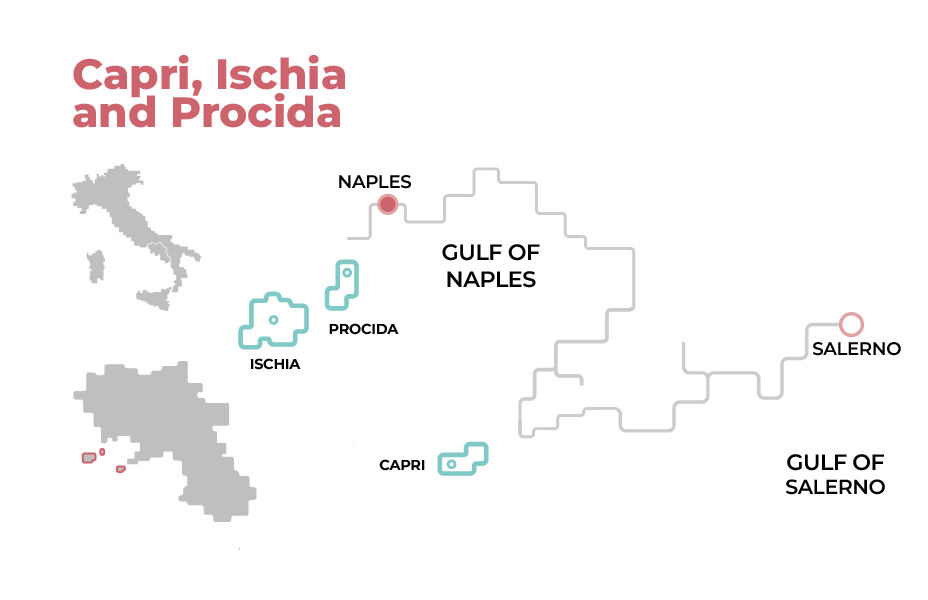
The Gulf of Naples is home to some of the Mediterranean’s most beautiful and celebrated islands, destinations that, for over a century, have drawn travelers, artists, and royalty from across the globe.
To speak of the islands of Campania is to describe three distinct personalities: Capri, elegant and cosmopolitan; Ischia, lush and renowned for its thermal springs; and Procida, authentic and intimate, the Italian Capital of Culture in 2022.
Alongside these lie lesser-known gems like Nisida and Vivara, rounding out an archipelago that offers remarkably diverse travel experiences within just a few kilometers of one another.
Whether planning a weekend getaway from Naples or a longer summer holiday, visitors to these islands discover a unique blend of landscapes, history, and gastronomy that is hard to match anywhere else in Italy.
Capri: An Enduring Legend
Capri is arguably Italy’s most photographed and celebrated island, and it is no coincidence that its name is synonymous with a glamorous Mediterranean getaway.
Accessible by ferry or hydrofoil from Naples, Sorrento, and, during peak season, Positano and Amalfi, the island is essentially divided into two main hubs: Capri town, home to the famous “Piazzetta” (which transforms into the ultimate social hotspot at night), and Anacapri, a quieter, more scenic area dominated by Mount Solaro, which is easily reached via chairlift.
The “Faraglioni“, three towering limestone stacks rising from the turquoise sea, remain the island’s iconic landmark; they are best admired both from the water on a boat tour and from above, along panoramic trails like the one leading to Punta Tragara.
Another must-see is the Blue Grotto (“Grotta Azzurra”), one of the world’s most famous sea caves, where light filtering through the water creates a distinctive, luminous glow that draws thousands of visitors each year.
Hiking enthusiasts shouldn’t miss the “Sentiero dei Fortini” (Forts Trail) or the walk to Villa Jovis, the island residence chosen by Emperor Tiberius, which offers breathtaking views of the Gulf of Naples and the Sorrentine Peninsula.
While Capri is renowned for high-end shopping, historic boutiques, Michelin-starred restaurants, and a nightlife scene unrivaled among the islands of Campania, it also retains authentic, tranquil spots, such as the Gardens of Augustus or the Charterhouse of San Giacomo, perfect for those seeking a moment of peace away from the crowds.
Ischia: The Green Island of Thermal Springs and Beaches
Ischia is the largest island in the Gulf of Naples and is renowned worldwide for its thermal waters.
These waters gush naturally from the volcanic subsoil, feeding thermal parks scattered across the island, from Ischia Porto to Forio, and from Casamicciola to Sant’Angelo.
It is no coincidence that Ischia is often called the “island of wellness“; the healing properties of its waters were known as far back as Roman times, and today they make the island an ideal destination not only for summer beach holidays but also for relaxing getaways in autumn and spring.
The Aragonese Castle, connected to the main island by a stone bridge, is undoubtedly Ischia’s most iconic landmark; this fortress rises from a small volcanic islet, bearing witness to centuries of history through its fortifications, convents, and panoramic views that sweep across the entire gulf. Nature lovers will find a challenging yet rewarding hike up Mount Epomeo, the island’s highest peak, while those seeking crystal-clear waters can choose between Maronti Beach, one of the largest in Campania, and Sorgeto Bay, where natural thermal springs mingle directly with the sea to create warm, open-air pools.
The village of Sant’Angelo, with its colorful houses and intimate harbor, is the perfect spot for an evening stroll or a fresh seafood dinner, while Forio, home to the seaside Church of Soccorso, offers one of the most breathtaking sunsets on the island.
Ischia is thus a well-rounded destination, offering a perfect blend of thermal relaxation, unspoiled nature, and authentic village life.
Procida: color and authenticity just a stone’s throw from Naples
Procida is the smallest and most intimate of the islands in the Gulf of Naples, yet in recent years it has gained increasing popularity, culminating in its designation as the Italian Capital of Culture for 2022.
Its seaside hamlet of Corricella, with colorful facades overlooking the small fishing harbor, is one of the most photographed spots in Campania and served as the backdrop for famous films such as “Il Postino”.
Unlike Capri, Procida has retained a slow, authentic pace of life: here, the scent of lemon groves fills the narrow streets, colorful boats rest on Chiaiolella beach, and religious traditions, such as the Good Friday “Misteri” procession, still engage the entire island community today.
The island is easily explored on foot or by bicycle, offering stunning views ranging from Terra Murata (the island’s highest point, home to the ancient Abbey of San Michele Arcangelo) to the tiny island of Vivara, a nature reserve connected to Procida by a pedestrian bridge and a haven for biodiversity unique to the Mediterranean
Those seeking the sea will find the clearest waters at “Il Postino” beach and Chiaia, while in the evening, Marina Grande and Corricella come alive with restaurants serving seafood dishes and the famous lemon salad, a local specialty made from the citrus fruits grown on the island.
Nisida and the gulf’s other small islands
Beyond the three major islands, the Campanian coast is home to other small islands—lesser-known yet equally fascinating.
Nisida, a tiny volcanic islet connected to the Neapolitan mainland by a short bridge, lies in the Bagnoli district; although largely occupied today by a juvenile detention center, it remains a place of great scenic beauty, distinguished by the crescent shape formed by its ancient crater.
Vivara, previously mentioned in connection with Procida, is a state nature reserve of immense environmental value, making it an ideal destination for birdwatching and nature trekking enthusiasts.
Together, these small islands complete the mosaic of the Campanian archipelago and bear witness to the rich geological, natural, and cultural history of the Gulf of Naples.